Alum Rock Park
Alum Rock Park Restoration Projects
Alum Rock Park, founded in 1872, was the very first municipal park in the state of California. The park’s 740 acres are located within the Alum Rock Canyon in the foothills of the Diablo Mountain Range. Since the park has never been used as rangeland, it is still home to many species of native plants that have been lost from other parts of San Jose. Slopes and riparian areas provide many different microclimates and host a wide range of plant species that make this park especially deserving of conservation efforts.
Come help us weed non-native, invasive plants at this natural gem of San Jose. Our habitat restoration efforts allow the native plants to “come to light.” Our workdays take place every Monday and Wednesday at 8:30 am, and on the second Saturday morning of each month. No experience is necessary. All tools and instruction will be provided. Please bring a filled water bottle, snacks, sunscreen, sunhat and insect repellent if you need it; wear trail/off-trail footwear, long pants and a long-sleeved shirt. New volunteers are welcome!
Forms and reservations are required to volunteer. Start by visiting the City’s volunteer opportunities page at www.sanjoseca.gov/your-government/departments-offices/parks-recreation-neighborhood-services/get-involved/volunteer-with-us. You will see Alum Rock Park Trail Crew as one of the options. For the Monday/Wednesday workdays, our actual meeting spot can vary and on rare occasions we may cancel due to weather or dangerous conditions. Please contact Todd Hayes at
Inspiration Point at Alum Rock Park
 Inspiration Point in Alum Rock Park is a beautiful location with great views of San Jose and the Bay. There is a fine selection of mature native trees and shrubs, but at the time the project started, invasives were taking over large sections.
Work started in 2011 and since then has met at least once a month on the third Saturday of the month. The group is called Weed & Walk as we try to include some education in each meeting. Volunteers meet at the maintenance area near the log cabinat 9am sharp. If you are volunteering identify yourself as a volunteer at the entry kiosk and the entry fee will be waived. Drive to the farthest parking lot, and park at the first bridge (across from the Log Cabin). Walk across the bridge and past the Log Cabin. Meet at the Maintenance Bldg at 9 am for orientation and training. Together the group will walk up to Inspiration Point, work there for approximately 2 hours, then walk back down to the parking lot. Dress in layers, appropriately for the weather. Wear hiking boots and a cap or hat. Bring water, sunblock, sturdy weeding gloves, weeding tool (optional). Rain cancels.
Fire Meadow Restoration
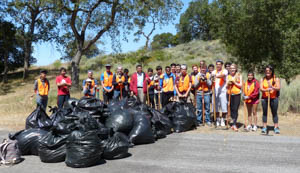 The Fire Meadow is part of a mixed oak woodland above Inspiration Point at Alum Rock Park. Work on this area started in 2013 after a small fire there reduced the canopy and provided a chance for weeds to take over large parts of the area. Thistle was rampant by the time the restoration effort started. Because it is upslope from the Inspiration Point restoration, it was a good candidate for a new restoration.
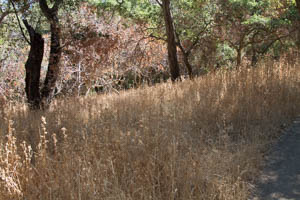 With plenty of volunteer labor, we have cleared this newer restoration area, and are now seeing the return of natives to the area. We have large populations of Hedge Nettle, Soap Lily, and Pacific Sanicle. We have also seen a few Ithuriel’s spear. In 2014 Central Coast Wilds nursery donated 60 trees to our restorations and 56 of those trees have been planted at these two restoration sites as well as a new site at the top of the Todd Quick Trail. To protect the trees from browsing deer, we have installed a number of plant cages. We have also propagated several hundred other natives from seed gathered at the park. These include various grasses, flowers and shrubs.
Quick Trail Restoration
The Quick Trail Restoration was started in 2014. The restoration is at the very top of the Quick Trail and has wonderful views of Santa Clara County, from the bay and Palo Alto (on a clear day) to Morgan Hill. The area was chosen because of the very large populations of Poison Hemlock and the possibility that all that seed 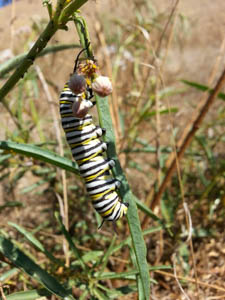 would, over time spread downhill over much more of the park. The area is downhill from OSA's Sierra Vista Open Space Preserve, so it gets more moisture than much of the other south facing slopes. Now that most of the weeds are cleared, we're seeing natives like the narrow leaf milkweed popping up arround the rocks, where there is more moisture (photo taken end of August 2015).
There is a much larger population of milkweed in Sierra Vista, and we look forward to more plants on "our side of the fence" now that they are not being shaded out.
We've planted a number of Buckeyes and Elderberrys in the area, and hopefully they'll do well here. Volunteers on this project work on Monday mornings. They meet at the end of the Mineral Springs parking lot just past the Youth Science Institute (YSI) at 8:30am. The group walks to the restoration site from there. It's important to arrive on time. Tools and gloves are available, but if you prefer to use your own, please feel free to bring them. Bring water as it can get hot, and there is no water available close to the site.